Stretch forming is widely used in industries such as architecture, aerospace, rail transit, and automotive manufacturing. Its ability to produce precise, repeatable curves makes it a preferred aluminum bending method for large-radius, high-accuracy components. However, whether an aluminum material can be successfully stretch formed depends on its alloy grade, the form of the material (extruded profiles or sheet), and the bending radius requirements. This article provides a structured and practical reference for material selection and process planning.
1. Aluminum Alloy Grades Suitable for Stretch Forming
From the perspective of alloy grades, aluminum materials that combine moderate strength with good ductility are generally well-suited for stretch forming. Alloys in the 1xxx, 3xxx, and 5xxx series—such as 1100, 3003, and 5052—have high elongation and excellent toughness, making them suitable for forming large, smooth curves. The 6xxx series, represented by 6061 and 6063 in the T4 or O temper, is also widely used because its balanced strength and ductility allow stable forming performance for architectural and transportation components. In contrast, high-strength 2xxx and 7xxx series alloys often exhibit limited formability, and stretch forming them requires very strict control of process parameters.
Source: Aluminum Standards and Data (AA)
2. Material Forms: Extruded Profiles vs. Sheet — Different Stretch Forming Behaviors
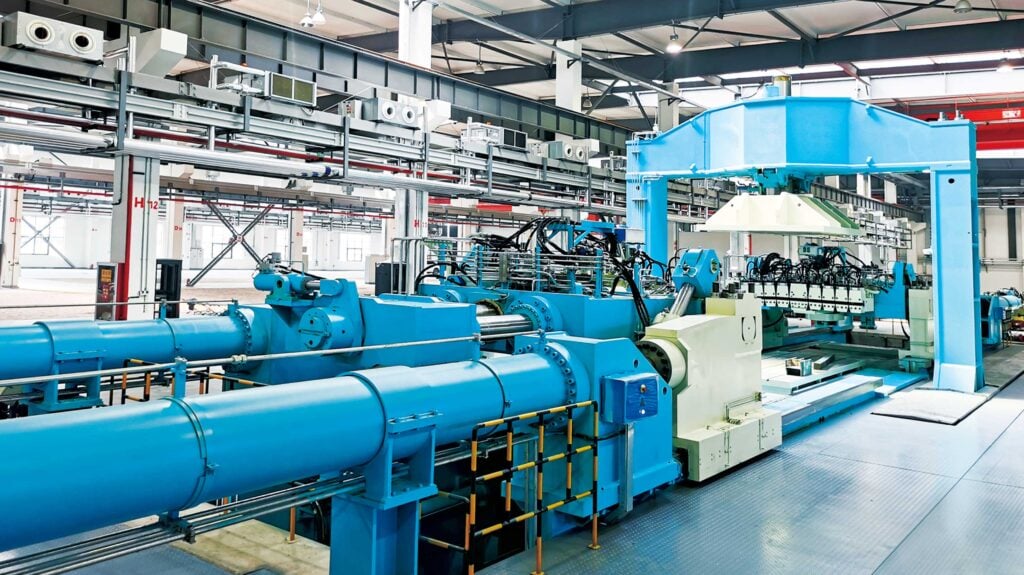
From the standpoint of material forms, extruded aluminum profiles and aluminum sheets show significantly different behaviors during stretch forming. Extruded profiles usually have complex cross-sections, varying wall thicknesses, and larger moment of inertia, meaning the forming result is heavily influenced by cross-sectional stiffness. During stretch forming, hollow profiles or multi-cavity profiles tend to deform unevenly and require higher tensile force and more precise control by the stretch forming machine to avoid twisting, rippling, or flattening. Sheet materials, by contrast, have uniform thickness and continuous surfaces, so tensile stress distribution is more uniform, resulting in smoother deformation and greater tolerance for small-radius aluminum bending.
Source: Aluminum Extruders Council (AEC) Forming Reference
3. Bending Requirements: Minimum Radius Based on Cross-Section Rather Than Alloy Grade
From the perspective of bending requirements, the minimum bending radius in stretch forming and roll bending is determined more by the cross-sectional geometry than by the alloy grade alone. Simple, symmetric profiles with balanced wall thickness can achieve smaller radii because stress flows more evenly during stretching, reducing the risk of buckling. Profiles with deep grooves, asymmetrical shapes, or thick-walled cavities require a larger bending radius since these geometries are prone to compression wrinkles or surface distortion. For aluminum sheets, minimum radius recommendations are typically tied to sheet thickness—thin sheets allow tighter curves, whereas thick plates require significantly larger radii to prevent cracking. When a project demands tight-radius aluminum bending, engineers can combine stretch forming with auxiliary techniques such as mandrels, internal pressurization, or pre-stretching.
Source: ASM Metal Forming Handbook
Conclusion
Whether an aluminum material can be stretch formed depends on alloy grade, product form, and the geometric limitations of its cross-section. Soft-temper 1xxx, 3xxx, and 5xxx alloys, as well as 6xxx alloys in T4 or O temper, offer the most stable performance. Extruded profiles and sheets behave differently during stretch forming because of their structural characteristics, while minimum bending radius is determined mainly by cross-sectional stiffness. By selecting a suitable stretch forming machine or aluminum profile rolling machine and adjusting parameters accordingly, manufacturers can achieve high-precision aluminum bending results for architectural façades, aerospace components, and transportation parts.
Aluminium is a widely used metal known for its lightweight, corrosion resistance, and excellent thermal and electrical conductivity. Its versatility and abundance make it a popular choice for various applications, ranging from aerospace and automotive to construction and consumer goods. One question that often arises is whether aluminium can be stretched.
Aluminium’s excellent formability allows it to be stretch formed into complex shapes, and for precise bending of extrusions, a dedicated stretch bending machine provides consistent results.
References
- 5052 Aluminum – Properties & Forming Characteristics Metal Zenith Engineering Datasheet. https://www.alekvs.com/5052-aluminum-guide-properties-applications/
- 3003 Aluminum Alloy – Cold Workability & Bendability JHP Metal Fabrication – Precision Aluminum Bending Overview. https://www.jhpim.com/news/precision-aluminum-bending/
- 6061 vs 5052 Aluminum – Strength & Formability Comparison Thomasnet Engineering Guide. https://www.thomasnet.com/articles/metals-metal-products/6061-aluminum-vs-5052-aluminum/
- Analysis of Formability on Aerospace Grade Aluminum Alloys International Journal of Engineering Research & Technology (IJERT), Vol. 4 Issue 10. (Includes forming limit diagrams, stretch forming suitability of 5052 & 6061 alloys.) https://www.ijert.org/research/analysis-of-formability-on-aerospace-grade-aluminum-alloys-IJERTV4IS100229.pdf
- Best Aluminum Alloys for Bending SinoExtrude Technical Article – Bendability of Aluminum Alloys (3003, 5052, 6061-O/T4). https://sinoextrud.com/best-aluminum-for-bending-which-aluminum-alloy-is-best/
- Aluminum Extrusion: Alloys, Process & Applications Langhe Industry – Overview of 6xxx Series Extrusion Characteristics. https://langhe-industry.com/zh/aluminum-extrusion/
- Aluminum Plate & Sheet Forming Guide Coffman Metal Products – Aluminum Sheet Bending Insights. https://www.coffmanmetalmembers.com/post/aluminum-sheet-bending/
- Formability of Aluminum Sheet ASM International – Materials Data & Handbook Summaries (public excerpts). https://asm.matweb.com/search/Aluminum-Forming-Properties.aspx (public data summary)